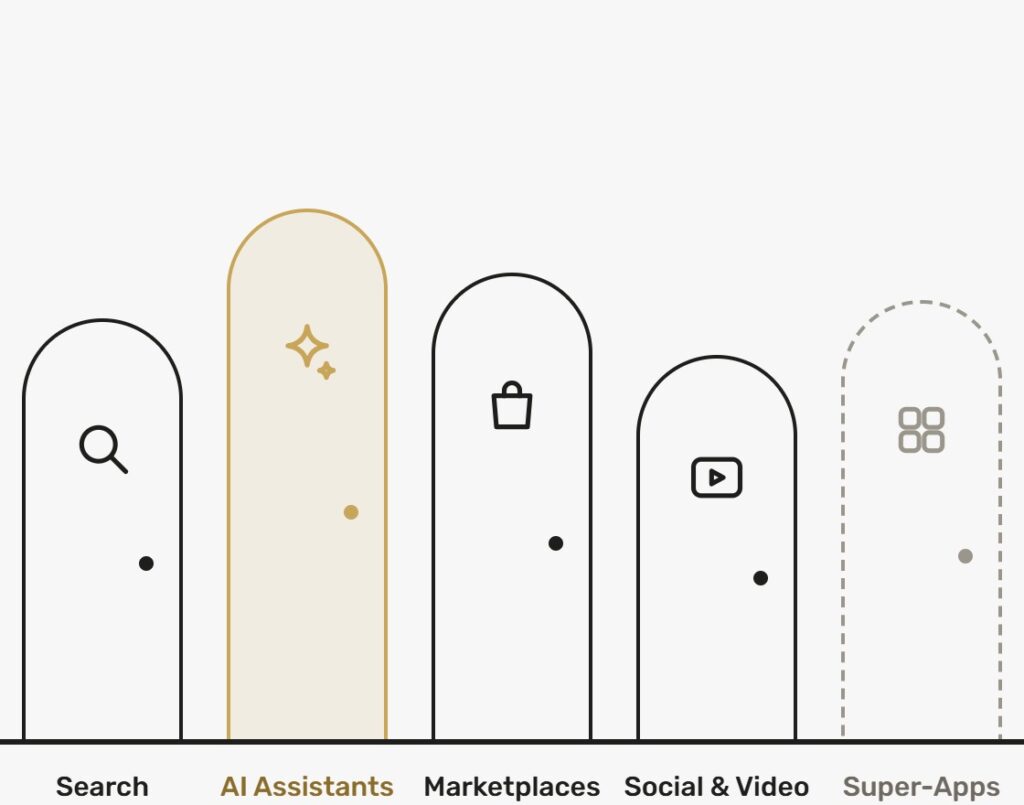
Customers don't find brands through a single search box. They ask AI assistants, browse marketplaces, scroll social feeds and search in apps. Each of these routes work differently.
This framework shows you which of those doors matter for your brand, and where to focus first. There's a free scorecard at the end so you can run it on your own brand.
Who Is This Framework For?
This framework is intended for anyone working with a brand in the overarching sphere of "search". This could originate at the point of SEO, paid search, marketplaces, social platforms, and of course, AI assistants.
Viewing "search" as an acquisition channel outside of a single lens, be it SEO or paid, isn't a new concept. However, each medium, or "door", still has its own rules, signals and gatekeepers.
The Many Front Doors is a simple model for working out which doors matter for a brand, how strong the brand is behind each one, and where to invest next.
Where Does This Framework Come From?
As mentioned, the concept of looking beyond "just SEO" or any other channel involving search isn't a new one.
I, and many others, have been talking about "breaking down silos" across marketing channels for some time now. From an SEO and AI search lens, I talk about it here, here, here, and more specifically, here.
Outside of breaking down silos, perhaps a better reframe is treating search as one customer journey with many entry points, rather than a set of channels owned by separate teams.
I've long been of the opinion that the SEO consultant is in a strong position to get to grips with this, given that so much of the work of the SEO consultant influences (or has the potential to influence) many areas of a business from audience research to user journeys to conversion.
The thinking also comes from my experience with the Chinese digital ecosystem, and how in China, there has never been a single front door of user acquisition, and multi-channel search optimisation is a must.
While SEO in China may immediately translate to optimising for Baidu, this also has to extend to WeChat, Xiaohongshu (Little Red Book), Douyin, marketplaces and AI assistants such as Doubao and DeepSeek.
The West has also firmly arrived at a similar place. AI assistants, social platforms and marketplaces all take a share of discovery from Google. In recent years, AI assistants have really sped this up and focused minds on optimising cross-channel when it comes to search.
How To Interpret This Framework
While channel-specific tactics and strategies still must be considered, the idea of The Many Front Doors approach looks beyond this and give brands a primer as to where they can look to focus their efforts, and how the doors can potentially complement each other in the overall acquisition funnel.
Looking beyond one channel doesn't mean being everywhere at once. It means seeing every door your customers use, so you can choose deliberately where to invest and how the doors support each other, rather than defaulting to the one your team happens to own.
I will walk through the framework in detail next, and will follow this up with a live example of the framework in action (complete with actionable next steps) for a hypothetical scenario.
Establishing the Framework Through Your Brand's "Doors"
The diagram below shows five potential main doors customers use to discover, compare and choose brands, with example platforms behind each:
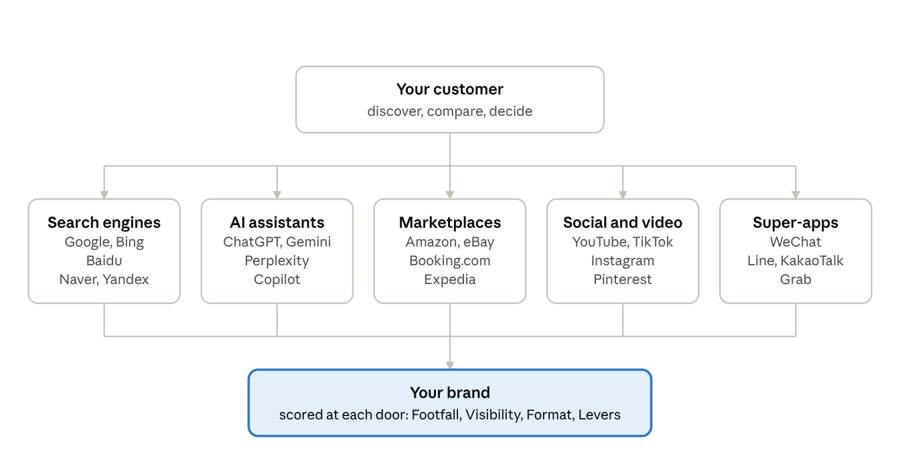
The five doors are a flexible starting list. Add, merge or rename doors to fit the brand accordingly. Which ones matter, and which platforms sit behind each will of course depend on the category and the market. A fashion brand in China and an ecommerce brand in Germany will draw very different maps.
Answer These Four Questions for Every Door
Each door is judged on the same four questions, always asked in this order, so doors can be compared side by side.
| Question | What you are checking |
|---|---|
| 1. Footfall. Do our customers come through this door? | Whether people use it to discover, compare or decide in this category and market. |
| 2. Visibility. Are we there when they arrive? | How often and how prominently the brand appears, and whether it is described accurately. |
| 3. Format. Do we speak this door's language? | Whether content and data are in the shape the door consumes: structured data, video, Q&A, local language. |
| 4. Levers. Can we influence it ourselves? | Owned content, product feeds, listings, reviews, PR, partnerships, technical access. |
Score Each Question From 0 to 3
| Score | Meaning |
| 0 | Absent or unknown |
| 1 | Present but weak or accidental |
| 2 | Solid, managed by someone |
| 3 | A strength we deliberately invest in |
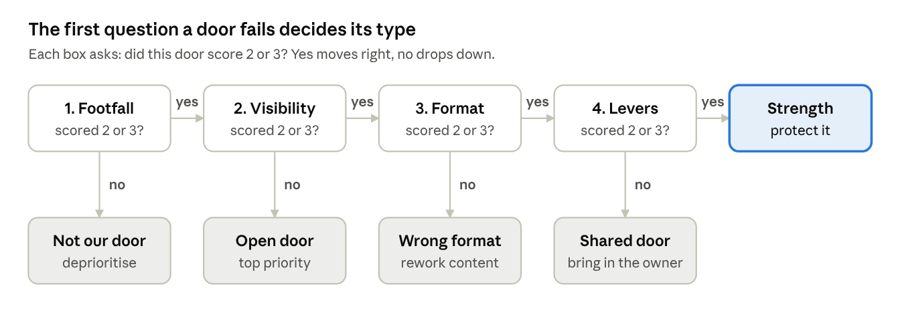
A score of 2 or 3 is a pass; 0 or 1 is a fail.
Passes and fails decide each door's type, detailed in the next section. The exact number then sets priority.
Reading the Scores
Ask the four questions in order. Stop at the first question a door scores 0 or 1 on: that question decides the door's type. If a door scores 2 or more on all four, it's a Strength.
For example, a door scoring Footfall 3, Visibility 3, Format 2 and Levers 1 is a Shared door. More on the door types in the table below.
| Door type | What it means | What to do |
|---|---|---|
| Not our door | Customers rarely use it | Deprioritise; re-score at the next review |
| Open door | Customers are there; the brand is not | Top priority: get present |
| Wrong format | The brand shows up, but in a form the door does not favour | Rework content and data into the shape this door uses |
| Shared door | It performs, but another team or partner controls it | Agree goals with whoever owns it |
| Strength | Passes all four | Protect it and keep re-scoring |
The question here might shift from "how is our SEO?" to "which doors are we missing customers at, and who fixes each one?"
Running a Many Front Doors Review
A review fits on one page and can be run for any brand, in any market.
- List the doors. Start from the customer, not the channel plan: where do people discover, compare and decide in this category, in this market?
- Score each door on Footfall, Visibility, Format and Levers (0–3).
- Name each door's type. The first question it fails decides it. Open doors are the priority list.
- Check who owns each door. Many doors (marketplaces, social, PR) sit outside the SEO team. Name an owner or a partner for each.
- Pick two or three doors to strengthen this year, and one to stop worrying about.
- Re-score every six months. Doors open and close quickly; the review is a living map, not a one-off audit.
The output is a single table of doors and scores that leadership can read in a minute.
Worked Example: a Premium Outdoor Clothing Brand
Below is an illustrative review for a fictional global outdoor clothing brand that sells through its own site and retail partners, with hypothetical scores.
| Door | 1. Footfall | 2. Visibility | 3. Format | 4. Levers | First fail | Door type |
|---|---|---|---|---|---|---|
| AI assistants | 3 | 1 | 1 | 1 | Visibility | Open door |
| Social and video | 2 | 2 | 1 | 2 | Format | Wrong format |
| Marketplaces | 3 | 3 | 2 | 1 | Levers | Shared door |
| Search engines | 3 | 3 | 2 | 3 | None | Strength |
| Super-apps | 1 | 0 | 0 | 1 | Footfall | Not our door |
What This Means for This Brand
- AI assistants (open door): the priority. Shoppers ask assistants which waterproof jacket or walking boots to buy, and competitors get recommended. Publish clear product specs and comparisons assistants can use, and bring in PR to influence the reviews they draw on.
- Social and video (wrong format): the brand appears, but with catalogue imagery where short how-to and field-test videos win. Rework existing content into that format.
- Marketplaces (shared door): products sell well on Amazon, but the retail partnerships team controls listings. Agree targets with them rather than optimising in isolation.
- Search engines (strength): keep investing and re-score in six months.
- Super-apps (not our door): little use among its customers outside Asian markets. Leave alone unless those markets become a focus.
Next Steps by Door
AI Assistants (Open Door)
- Who to involve: SEO lead (owner), PR and comms, product content and merchandising, ecommerce developers for structured data
- What to measure: how often the brand is mentioned for a fixed set of buying prompts ("best waterproof jacket for hiking"), whether products are described accurately, referral visits from AI assistants
- Tactics: clear spec and comparison pages (fabric, waterproof rating, fit); product schema and clean product feeds; coverage in the review and "best of" articles assistants draw on; answers to common buying questions on category and product pages
Social and Video (Wrong Format)
- Who to involve: social team, brand and creative, content team, athlete and ambassador partners
- What to measure: visibility in YouTube and TikTok search for category terms, video views and saves, engagement on product videos
- Tactics: short field-test and how-to videos ("how to layer for a winter hike"); turning existing product shoots into short video; titles and captions written for platform search; creator partnerships
Marketplaces (Shared Door)
- Who to involve: retail partnerships or marketplace manager, ecommerce trading, finance
- What to measure: marketplace search rank for priority products, listing completeness, share of sales through marketplaces versus the brand's own site
- Tactics: product titles and attributes that match how shoppers search on Amazon; the same specs and imagery across own site and listings; a shared keyword list between SEO and the marketplace team; a review-generation programme
Search Engines (Strength)
- Who to involve: SEO team, web developers, content team
- What to measure: organic visibility for category terms, non-brand clicks and revenue, site performance
- Tactics: keep technical health in check; refresh top category pages; feed what is learned at other doors back into site content
Super-Apps (Not Our Door)
- Who to involve: regional or international teams, only if expansion into Asian markets is planned
- What to measure: footfall again at the next review
- Tactics: none for now; monitor
The Scorecard
To run this yourself for your own brand, copy it from here, or export the doc yourself to use it offline.
| Brand | Market | Category | Reviewed by | Date |
|---|---|---|---|---|
| Door | 1. Footfall (0–3) | 2. Visibility (0–3) | 3. Format (0–3) | 4. Levers (0–3) | First fail | Door type | Owner | Next step |
|---|---|---|---|---|---|---|---|---|
| Search engines | ||||||||
| AI assistants | ||||||||
| Marketplaces | ||||||||
| Social and video | ||||||||
| Super-apps | ||||||||
| Other door | ||||||||
| Other door |
How to fill it in
- Score: 0 = absent or unknown, 1 = present but weak, 2 = solid and managed, 3 = a deliberate strength. A 2 or 3 is a pass.
- First fail: read each row left to right and note the first question scoring 0 or 1.
- Door type: Footfall fails = Not our door · Visibility fails = Open door · Format fails = Wrong format · Levers fails = Shared door · no fails = Strength.
- Priority: Open doors first. Within the same door type, start with the higher Footfall score.
- Re-score every six months.
Final Thoughts
Search has never really been one channel, and it's becoming less so every month. The brands that do well won't be the ones trying to be everywhere at once, but the ones that know which doors their customers walk through and make sure they're standing behind the right ones.
The Many Front Doors is designed as a simple way to start that conversation inside your organisation, and the scorecard gives you a primer to get started.
If you'd like help running a review for your brand, or just want to compare notes on what you find, I'd love to hear from you.

Let’s Talk
I’m a senior SEO consultant with 15+ years experience supporting brands with organic
growth from technical foundations to content strategy and visibility across AI search
platforms.